Concepts
Hub-and-Spoke vs Point-to-Point
.jpg?width=1600)
Photo: simon butler from halesowen, uk — CC BY 2.0
Almost every case study on this site refers back to one of these two shapes. Understanding the actual difference — not the one-line dictionary version — is what makes the rest of the strategy pieces click into place.
Hub-and-spoke: one gateway, many spokes
An airline running hub-and-spoke concentrates its network through one (or a small number of) central airports. A passenger flying Nairobi to Tokyo on Turkish Airlines doesn’t fly direct — they fly Nairobi to Istanbul, then Istanbul to Tokyo, changing aircraft in between. The airline is selling connections, not point-to-point capacity: it needs enough passengers wanting any combination of its spoke cities to fill a widebody on each leg, which a single city pair almost never could alone.
This is why Emirates, Qatar Airways, Turkish Airlines and Etihad all built their entire strategy around one hub city — Dubai, Doha, Istanbul, Abu Dhabi — rather than flying point-to-point everywhere. None of those cities has anywhere near enough local demand to fill the widebody fleets these airlines operate. The hub exists specifically to aggregate passengers from many origins into large enough onward flows to justify large aircraft on long routes.
Hub-and-spoke
Turkish Airlines: real long-haul connections through Istanbul
Watch what the two sizes of pulse are doing: small feeder traffic flows in from each spoke, consolidates at Istanbul, then a single larger departure carries it onward. That size difference is the actual reason hub airlines fly widebodies on the long legs — one aircraft only makes sense once several feeders’ worth of passengers have been combined onto it. All four spokes are real Turkish Airlines destinations.
Real airports at their real relative positions; lines are a handful of this airline’s real, individually verified routes — not its complete current network, which no schedule-data source here can confirm exhaustively.
Point-to-point: direct city pairs, no changing planes
Point-to-point airlines do the opposite: every route is sold to fill itself, not to feed a connection. Ryanair doesn’t need enough people connecting through Bergamo to Bucharest and onward somewhere else — it just needs enough people who specifically want to fly Bergamo to Bucharest, direct, on that one route. No hub city is structurally necessary at all; a point-to-point network can, and often does, connect two secondary cities that have never had a direct flight before, because the route stands on its own economics.
This is the structural reason low-cost carriers gravitate toward secondary airports (Bergamo instead of Milan Linate, Beauvais instead of Paris Charles de Gaulle): a point-to-point route doesn’t need the connectivity a major hub airport offers, so it can go wherever landing fees are lowest and turnaround is fastest, rather than wherever other airlines already concentrate their networks.
Point-to-point
Ryanair: real direct routes among five of its cities
The moving aircraft is one size the whole way round — it flies Bucharest to Bergamo, dims briefly (dropping off and picking up passengers), then continues straight to Barcelona, then Kraków, then Beauvais, never returning to a shared centre. Six real, individually verified Ryanair routes are drawn among these five cities in total — notice Barcelona–Kraków and Beauvais–Kraków don’t touch Bergamo at all. No single city has to be the centre for every route to work, and no leg needs a bigger aircraft than any other.
Real airports at their real relative positions; lines are a handful of this airline’s real, individually verified routes — not its complete current network, which no schedule-data source here can confirm exhaustively.
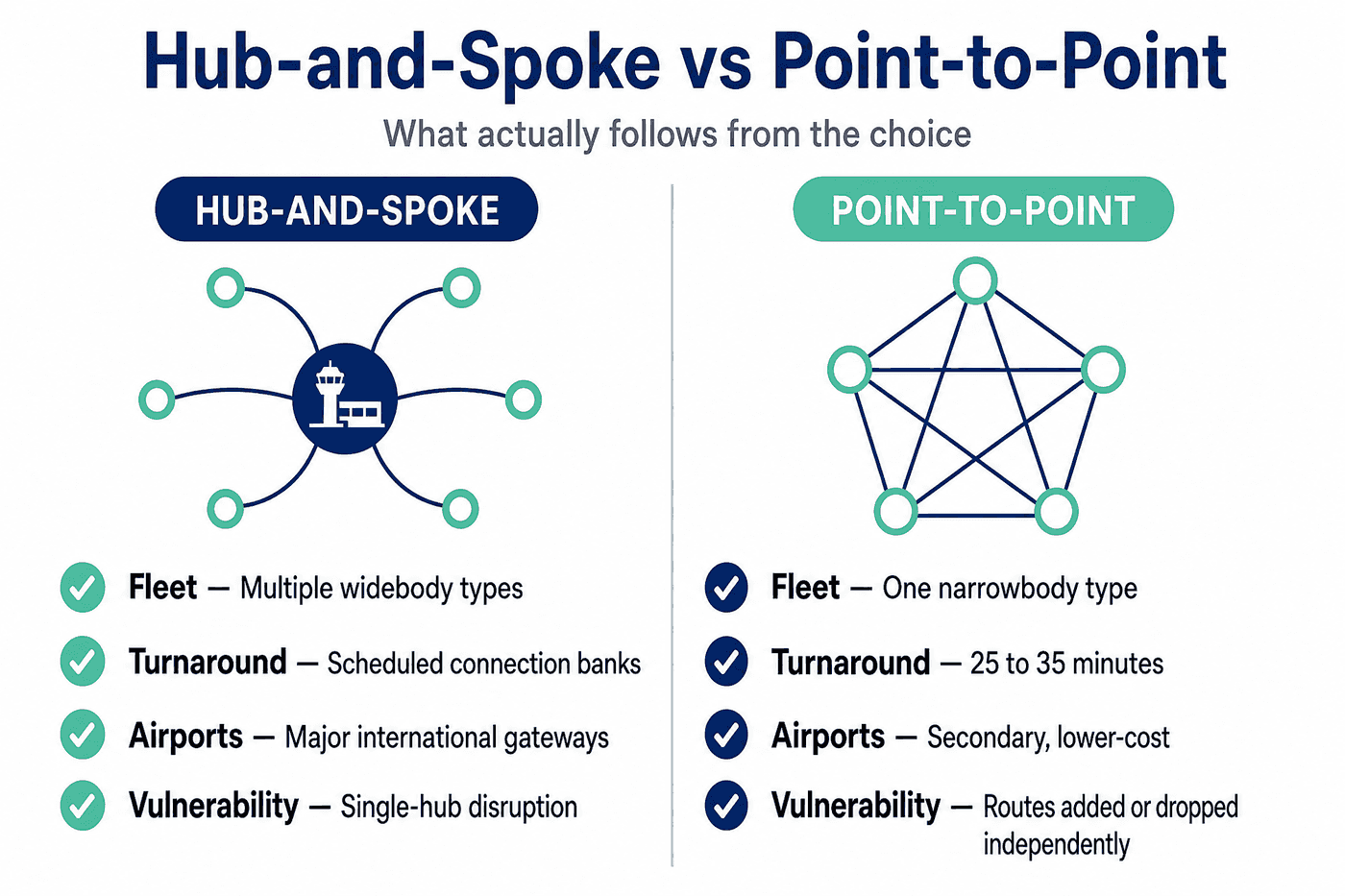
What actually follows from the choice
The network shape isn’t cosmetic — it determines almost everything else about how an airline is run:
- Fleet. A hub airline needs aircraft that can fill up from connecting traffic on long routes — widebodies, usually more than one type to match different route lengths (Emirates’ A380s and 777s, Qatar Airways’ A350s and 787s). A point-to-point airline wants one narrowbody type flown as many hours a day as possible — Ryanair and Southwest’s all-737 fleets, IndiGo’s all-A320-family fleet — because route-by-route simplicity, not connection-building, is the whole point.
- Turnaround time. A hub airline’s aircraft sit at the gate for a scheduled connecting window, timed to a “bank” of simultaneous arrivals and departures. A point-to-point airline’s whole economics depend on turning the aircraft around in 25–35 minutes and getting it back in the air, because an aircraft on the ground earns nothing.
- Airport choice. A hub airline needs a major international gateway with the slots, immigration capacity and connecting infrastructure to handle a bank of widebodies at once. A point-to-point airline actively avoids that congestion and cost, preferring secondary airports that will negotiate lower fees for guaranteed volume.
- Vulnerability. A hub airline is exposed to anything that constrains the hub itself — slot caps, a single airport’s bad weather, geopolitics affecting overflight rights. A point-to-point airline is exposed differently: any single route can be pulled or added quickly since nothing else in the network depends on it, but there’s no connecting traffic to fall back on if local point-to-point demand on a route dries up.
Neither model is simply “better” — they’re answers to different questions. Hub-and-spoke answers “how do I connect places that don’t have enough direct demand to justify a flight between them?” Point-to-point answers “how do I make every single route profitable on its own, with nothing subsidising anything else?” Every airline strategy case study on this site is, underneath the specifics, a variation on one of these two answers — or, for a handful of airlines, a genuine hybrid attempting both at once.