The Airline That Isn’t an Airline: Amazon Air’s Unresolved Bet on Operating Control
United States

Adam Moreira (AEMoreira042281) — CC BY-SA 4.0
Key Stats
- Total Active Fleet Size
- ~100–104 aircraft
- Outright Owned Airframes
- 11 Boeing 767-300ERs
- CVG Superhub Capital Investment
- $1.5 billion
- Sun Country Contract Fleet
- 22 Boeing 737-800BCFs
- A330-300P2F Fleet (Hawaiian)
- 10 aircraft in service
- Equity Warrants Held
- ~19.5% ATSG / Up to 15% Hawaiian
How it works
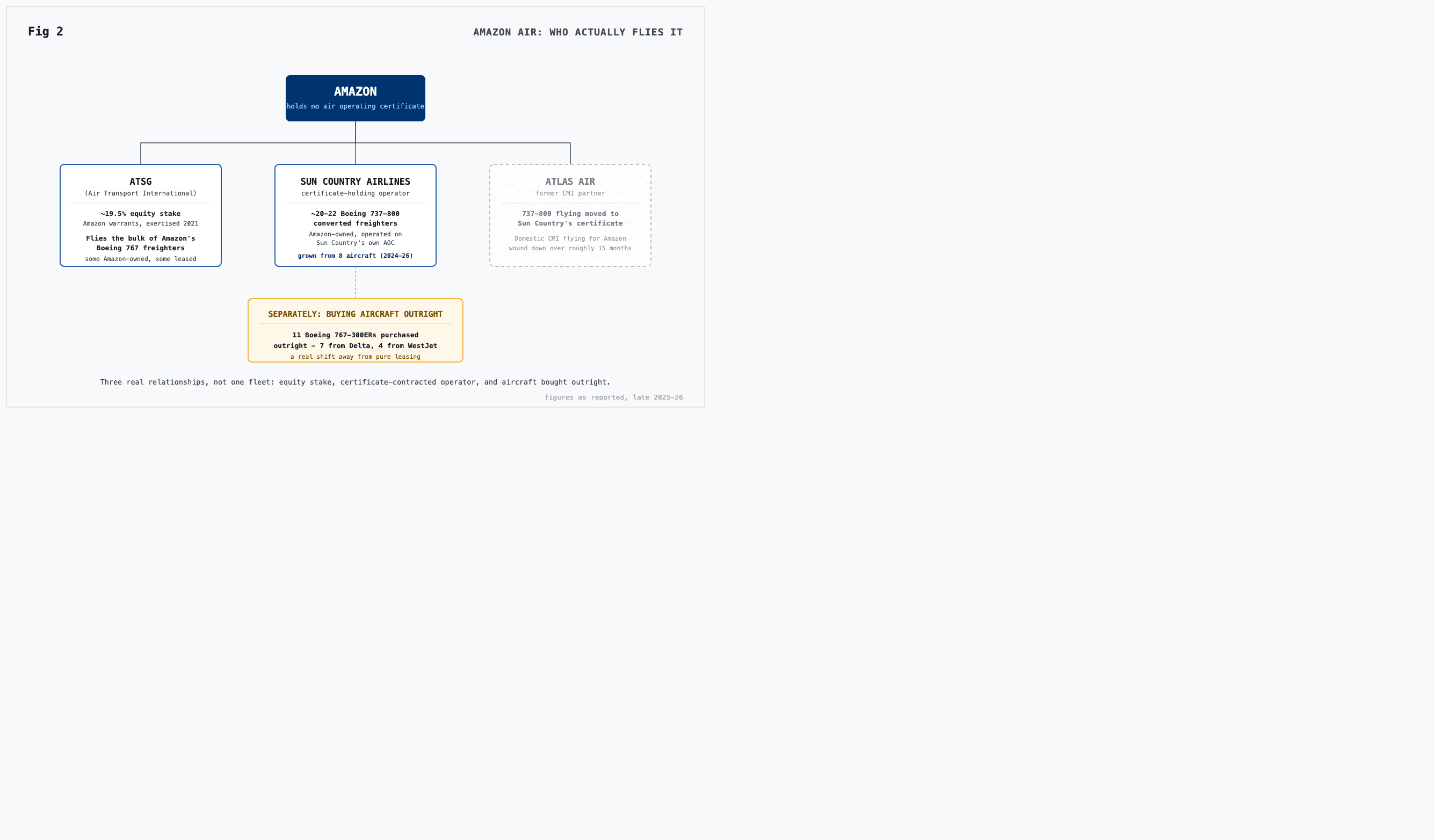
Amazon holds no air operating certificate of its own — every Amazon Air aircraft flies under another company’s certificate, through three genuinely different arrangements at once.
Where It Started: The Virtual Airline and the Logistics Bottleneck
In late 2015, Amazon faced a structural bottleneck that threatened the core mechanism of its Prime customer promise. As e-commerce order volumes surged toward peak holiday seasons, traditional express parcel integrators—specifically FedEx Express and UPS Airlines— struggled to offer Amazon guaranteed middle-mile capacity at sustainable unit costs. The retail giant found itself paying elevated spot market rates while remaining exposed to third-party network congestion, ground delays, and strict commercial cut-off times. Building an in-house logistics supply chain was a strategic priority, but creating a traditional certificated airline from scratch presented immense capital, operational, and regulatory barriers under United States Federal Aviation Administration (FAA) Part 121 regulations.
Establishing an independent Air Operating Certificate (AOC) requires years of regulatory auditing, dedicated safety management infrastructure, direct employment of flight crews under complex collective bargaining agreements, and heavy capital outlays for spares and heavy maintenance facilities. To circumvent these delays, Amazon conceived a model novel in scale: a “virtual airline” that decouples network design, technology, and package sortation from the physical operation of aircraft. Operating through an internal management unit named Fleet, Aviation Sourcing, and Technical (FAST), Amazon set out to control the routes, schedules, hubs, and package sortation while outsourcing the airframes, pilot rosters, maintenance programs, and regulatory liability to third-party air cargo carriers.
The Strategic Bet: Outsourcing the Certificate while Controlling the Grid
Amazon’s core strategic decision was to construct an air logistics network that functioned as a captive express carrier without incurring the institutional overhead of an AOC holder. Rather than purchasing new factory freighters or seeking an operating certificate, Amazon established long-term operational partnerships backed by significant financial commitments and equity-like incentives. In 2016, Amazon entered agreements with Air Transport Services Group (ATSG) and Atlas Air Worldwide Holdings. Under these initial agreements, the contract carriers supplied converted freighters under Crew, Maintenance, and Insurance (CMI) or Aircraft, Crew, Maintenance, and Insurance (ACMI) contracts, while Amazon secured warrant options allowing it to purchase minority equity stakes in its operating partners.
Through these warrant structures, Amazon accumulated roughly 19.5% of ATSG’s outstanding shares after exercising options originally tied to fleet expansion. A similar warrant package was structured into its later widebody agreement with Hawaiian Airlines, granting Amazon the right to acquire up to 15% of Hawaiian’s equity. This arrangement created a hybrid model: Amazon acted as a key commercial customer and significant minority shareholder, gaining strategic influence over its operational partners without consolidating their operational risk, union labor disputes, or regulatory exposure onto its balance sheet.
The arc
How the strategy played out
- 2016The bet
Initial CMI Partnerships Launched
Amazon launches Prime Air network with ATSG and Atlas Air CMI contracts, securing warrant options for partner equity.
- 2021Proof
CVG Superhub Opens & First Direct Aircraft Purchases
Amazon opens its $1.5B CVG hub and buys 11 Boeing 767-300ERs from Delta and WestJet, shifting from pure leasing to a hybrid ownership model.
- 2022Reset
Hawaiian Airlines A330 Partnership Announced
Amazon signs deal with Hawaiian Airlines to operate 10 leased Airbus A330-300P2F widebody freighters with 15% equity warrant option.
- 2024Reset
Atlas Air Exit & Sun Country Contract Expansion
Atlas Air agrees to exit domestic CMI flying for Amazon; Amazon expands Sun Country contract from 12 to 20 Boeing 737-800 freighters.
- 2025Proof
Final A330 Induction & Commercial Cargo Launch
Hawaiian inducts 10th A330-300P2F; Amazon Air Cargo expands sales of excess payload capacity to third-party freight forwarders.
- 2026Strain
Allegiant-Sun Country Merger & Miami 21 Air Incident
Allegiant acquires Sun Country while maintaining Amazon flying; Amazon pauses 21 Air operations following a fatal Miami 767 overrun.
Hub & Fleet Execution: Infrastructure, Aircraft Types, and Order-Book Reality
Execution of Amazon’s virtual airline model rests on two physical pillars: a central superhub network designed around rapid sortation and a carefully selected, multi-tiered freighter fleet.
The Hub/Network Architecture: The heart of Amazon Air’s network is its $1.5 billion primary air hub at Cincinnati/Northern Kentucky International Airport (CVG), which opened in August 2021. Spanning a 600-acre campus with an 800,000-square-foot automated sortation facility, CVG is engineered to handle dozens of daily flights and process millions of packages weekly. CVG puts roughly two-thirds of the U.S. population within a 600-mile flight radius, allowing Amazon to move inventory across regions in hours. CVG is supplemented by major regional air nodes including Fort Worth Alliance (AFW), San Bernardino (SBD), Wilmington Air Park (ILN), Lakeland Linder (LAL), and its European gateway at Leipzig/Halle (LEJ). According to ongoing spatial research by DePaul University’s Chaddick Institute for Metropolitan Development, over 80% of domestic U.S. Amazon Air flights touch one of its five primary hubs, marking a firm transition from early point-to-point experimentation to a structured hub-and-spoke express grid.
The Aircraft Fleet: Amazon’s fleet composition is built around specific payload and range tiers designed for domestic and regional package movement:
- Boeing 767-300F / BDSF / BCF: Serving as the operational backbone, the medium widebody 767-300 freighter offers a payload capacity of approximately 52 to 58 metric tons and a range of 3,250 nautical miles. Its main-deck cargo door accepts standard AAY/AAX containers, making it well-suited for high-density, mid-haul routes connecting regional sorting centers to central hubs.
- Boeing 737-800BCF: As a standard-body freighter carrying up to 23 metric tons over 2,000 nautical miles, the 737-800 converted freighter handles high-frequency, short-to-medium-haul feeder routes. Its lower trip cost and fuel burn allow Amazon to maintain high daily utilization across regional lanes.
- Airbus A330-300P2F: Representing Amazon Air’s largest aircraft type, the converted A330-300 widebody provides roughly 61 metric tons of payload capacity and 15–20% more volumetric space than the 767-300F. This increased volume is critical for e-commerce, where package density is low relative to physical box size.
The Order Book and Fleet Ownership Reality: Despite its asset-light origins, Amazon shifted strategy in January 2021 by purchasing 11 Boeing 767-300ER passenger aircraft outright—seven from Delta Air Lines and four from WestJet—and converting them into dedicated freighters. This marked the first time Amazon held legal title to aircraft airframes rather than relying strictly on operating leases. However, Amazon did not retain operating control: every owned airframe was immediately assigned to contracted carriers like Air Transport International (ATI) or ABX Air under CMI leases.
The execution of Amazon’s fleet transition has seen substantial reallocation between operating certificates. In May 2024, Atlas Air announced a mutual agreement to completely exit its domestic CMI flying for Amazon by mid-2025, phasing out 17 Boeing 767s and eight Boeing 737-800s to focus on long-haul international widebody operations. To absorb the narrowbody volume, Amazon signed an expanded, long-term agreement with Sun Country Airlines in June 2024. Under this deal, Sun Country expanded its Amazon-dedicated Boeing 737-800 freighter fleet from 12 to 20 aircraft by late 2025, with Amazon placing two additional 737-800 freighters on Sun Country’s certificate in mid-2026 to reach a total of 22 aircraft. Sun Country’s contract extends through 2030, with extension options through 2037. The operational arrangement was reaffirmed following the announcement of Allegiant Travel Company’s acquisition of Sun Country, with Allegiant leadership confirming that cargo operations remain a reliable, high-margin revenue contributor.
In the widebody segment, Amazon completed its 10-aircraft Airbus A330-300P2F lease program with Altavair in June 2025, when the tenth aircraft, named “Resilience,” entered service. All ten A330 freighters are operated by Hawaiian Airlines (now part of Alaska Air Group) under an eight-year CMI agreement. Out of an active global fleet of roughly 100 to 104 aircraft, Amazon owns fewer than 15 airframes outright, relying on leasing firms and contracted AOC holders for over 85% of its operating fleet.
Figures
Amazon Air Global Fleet Composition by Operating Partner
Approximate active fleet breakdown by primary aircraft type and operating partner.
Source: Chaddick Institute, Cargo Facts, Fleet Databases
Competitive Reality: Sizing Amazon Air Against FedEx, UPS, and ACMI Giants
To understand Amazon Air’s strategic position, its scale must be evaluated against traditional express integrators and wet-lease operators. While Amazon Air has built an impressive network in ten years, its fleet and operational metrics reflect a specific, targeted role within middle-mile e-commerce rather than a full-service global cargo airline.
FedEx Express operates over 650 dedicated aircraft, including heavy intercontinental freighters like the Boeing 777F and McDonnell Douglas MD-11F, generating tens of billions in air cargo revenue across global lanes. UPS Airlines operates a main-fleet array of roughly 290 widebody and narrowbody freighters centered around its massive Worldport hub in Louisville. By contrast, Amazon Air’s fleet sits at approximately 100 aircraft. Furthermore, Amazon Air does not operate long-range heavy widebodies such as the 777F or 747-8F, restricting its main transport network primarily to North American and intra-European logistics corridors.
Where Amazon Air excels is in operational agility and cost insulation. Traditional carriers carry enormous fixed capital overhead, aging fleet maintenance liabilities, and direct union pilot labor obligations. Amazon shifts those liabilities down the supply chain. If demand contracts or a contracted airline experiences labor friction, Amazon can reallocate airframes to another AOC holder—as demonstrated when it shifted 737-800 operations from Atlas Air to Sun Country Airlines, and 767s to ABX Air and ATI.
The Demand Side: Reach, Network Density, and Third-Party Commercialization
Amazon Air’s network exists primarily to serve internal fulfillment needs, but its commercial model underwent a major evolution in late 2024 and 2025 with the formal introduction of “Amazon Air Cargo.” Recognizing that its directional package flows created belly and main-deck capacity imbalances, Amazon began selling excess freighter payload to third-party freight forwarders, logistics providers, and charter brokers.
Tonnage and Operational Trajectory: Following years of rapid, double-digit flight expansion during the pandemic e-commerce boom, Amazon Air shifted focus toward network density and schedule optimization. According to Chaddick Institute findings, while daily flight departures stabilized around 200 to 250 flights per day across North America and Europe, total available ton-miles grew due to the induction of higher-capacity A330-300P2F widebodies and a higher proportion of nocturnal flying tailored for overnight package processing. Amazon Air’s network puts over 70% of the U.S. population within 100 miles of an Amazon-serviced airport.
Representative Route Structures and Contracts: Key transcontinental and regional lanes illustrate how Amazon utilizes its fleet matrix. High-density transcontinental trunk routes, such as Cincinnati (CVG) to San Bernardino (SBD) or Ontario (ONT), rely on A330-300P2Fs and 767-300s to move high volumes of consumer merchandise overnight. Regional feeder routes, such as Sun Country-operated 737-800BCF flights connecting CVG to regional nodes like Tampa, Lakeland, or Minneapolis, run on tight schedules designed to align with ground delivery van dispatch times.
The Commercialization Proposition: By offering ad-hoc charters, blocked-space agreements, and door-to-airport freight services under the Amazon Air Cargo banner, Amazon presents third-party shippers with a reliable alternative to traditional scheduled cargo carriers. Shippers choose Amazon Air Cargo due to its high network density across secondary, cargo-friendly airports (like SBD, ILN, and LAL) where congestion is lower and ground handling turns are faster than at crowded international gateways.
Figures
Sun Country Dedicated Amazon 737 Freighter Fleet
Growth in Boeing 737-800 converted freighters assigned to Sun Country's AOC.
2020
12 aircraft
2024
12 aircraft
2025
20 aircraft
2026
22 aircraft
Source: Sun Country Airlines SEC Filings & Company Reports
What the Evidence Shows: The Balance Between Asset Ownership and AOC Dependency
Analyzing the sequence of Amazon Air’s execution reveals a deliberate, unresolved strategy. On one hand, Amazon has taken steps that mirror a carrier building toward permanent operational ownership: it invested $1.5 billion in a dedicated superhub at CVG, purchased 11 widebody Boeing 767 aircraft, built an internal technical management organization (FAST), and launched commercial third-party cargo sales.
On the other hand, the core operational execution remains entirely reliant on third-party air operating certificates. Amazon holds zero regulatory authority from the FAA to dispatch, operate, or maintain commercial aircraft. Over 85% of its fleet remains owned by third-party lessors such as Titan Aviation Holdings, AerCap, Altavair, and ATSG. Furthermore, 100% of its flights are flown by contracted pilots under third-party operational management.
This structure was tested in September 2026, when 21 Air Flight 7598—a Boeing 767-300F operating on behalf of Amazon Air—suffered a fatal runway overrun during landing at Miami International Airport, resulting in five ground fatalities. Following the accident, Amazon made a commercial decision to pause its operating contract with 21 Air, illustrating the swift risk-isolation mechanism inherent in the virtual airline model. Because Amazon was not the AOC holder, regulatory enforcement and operational scrutiny were directed at 21 Air and federal safety investigators rather than grounding Amazon Air’s broader network or directly impacting Amazon’s corporate FAA standing.
Where This Leaves Amazon Air: The Unresolved Strategic Outlook
Amazon Air stands as aviation’s most advanced hybrid experiment—a giant air logistics provider that commands a 100-aircraft network without flying a single plane under its own regulatory certificate. The unresolved question is whether this model represents an enduring end-state or an intermediate stage on a path toward full carrier certification.
Staying a virtual airline allows Amazon to retain capital efficiency, shift labor and regulatory liabilities to CMI partners, and reallocate capacity across carriers as commercial conditions demand. However, it leaves Amazon vulnerable to contractor performance, labor instability at partner airlines, and reputational risk when safety incidents occur on aircraft bearing its corporate branding. Conversely, acquiring its own Part 121 certificate would grant Amazon total operational control, direct oversight of flight operations, and full integration of air crew scheduling with fulfillment algorithms—at the cost of vast capital commitment, regulatory exposure, and direct union labor negotiations.
As Sun Country integrates into Allegiant, as Hawaiian’s A330 operations mature under Alaska Air Group, and as ATSG prepares to introduce A330 freighters for Amazon starting in 2027, Amazon continues to refine its middle-mile machinery. The evidence confirms that Amazon has successfully constructed one of North America’s premier express air networks. Whether it will ever choose to fly those aircraft under its own operational certificate remains a strategic decision that Amazon has deliberately left open.
Network
Hubs & Reach
Within 4 hours
19
major metros · ~130M combined
Within 8 hours
32
major metros · ~194M combined
Within 12 hours
75
major metros · ~422M combined
Closest major markets
Rings mark the 4h and 8h bands; wider bands are listed above but not drawn, because a circle that large distorts badly on a flat map. Flying time is estimated from Cincinnati / Northern Kentucky as great-circle distance at a typical jet cruise speed plus a fixed allowance for taxi, climb and descent — an approximation for illustrating reach, not a schedule. Counts cover major world metro areas only (a fixed global list used for every case study on this site, so hubs are comparable); the population figure is the approximate combined metro population of those listed metros, not the total population inside the ring.
Sources & Further Reading
- Aerospace Global News - Who actually operates Amazon Air aircraft? ↗
- FreightWaves - Atlas Air to end Amazon flights, focus on international customers ↗
- Sun Country Airlines - Revised Agreement with Amazon Press Release ↗
- STAT Times - 'Resilience' joins Amazon Air as 10th A330P2F ↗
- DePaul University Chaddick Institute - Aviation and Amazon Air Briefs ↗
- Cargo Facts - Amazon Air: Routes, capacities and new strategies ↗
- CNN - Amazon Air cargo plane overruns Miami runway NTSB preliminary report ↗