Forced Aging and the $85M Jumbo Hedge: Inside Cargolux’s Dual-Fleet Bet
Luxembourg

4300streetcar — CC BY 4.0
Key Stats
- Net Profit (2025)
- $465 million
- Annual Revenue (2025)
- $3.406 billion
- Freight Volume (2025)
- 1.09 million tonnes
- Current Active Fleet
- 30 Boeing 747 freighters
- Secondhand 747 Acquisition
- 4 Boeing 747-400Fs ($85M)
- Firm Order Book
- 10 Boeing 777-8Fs (+6 options)
- Delivery Slippage
- 2027 to 2029 (2-year OEM delay)
- Shareholder Structure
- Luxair (35.1%), HNCA (35.0%)
How it works
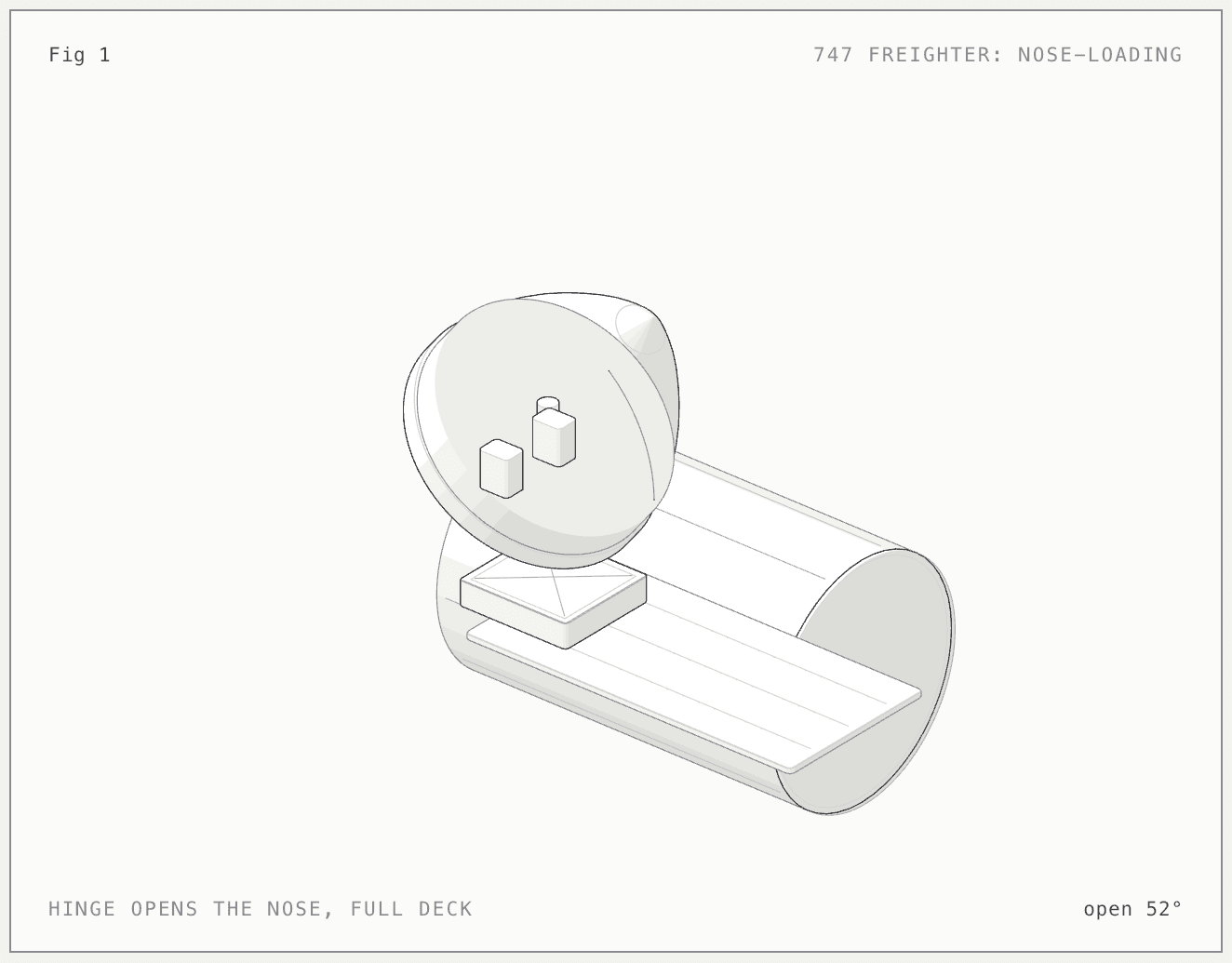
A 747 freighter’s hinged nose swings up and forward on a pivot near the top of the fuselage, clearing the full circular main-deck cross-section for straight-in loading — the mechanism Cargolux’s all-747 fleet is built around.
Where It Started: The Single-Type Monoculture and Luxembourg’s Capital Constraints
For more than five decades, Luxembourg-based Cargolux Airlines International S.A. built one of the air cargo industry’s most distinct operating models. Founded in 1970 by flag carrier Luxair, Loftleiðir, and private investors, the carrier evolved from operating legacy Canadair CL-44 turboprops into Europe’s largest pure-play, all-cargo airline. Central to its long-term financial stability was a relentless commitment to single-aircraft-type discipline. After moving through early jet eras with the Douglas DC-8, Cargolux standardized its operation around the Boeing 747 maindeck freighter platform, progressing from the 747-200F to the 747-400F, and eventually becoming the world’s launch customer for the stretched 747-8F in 2011.
This all-747 monoculture provided Cargolux with substantial structural unit-cost advantages. A single flight-crew type rating across the entire long-haul fleet maximized pilot utilization and drastically simplified roster management. Maintenance hangars at Luxembourg Airport (LUX) maintained a single inventory of spare parts, engines, and specialized tooling. Ground handling procedures were entirely uniform: every aircraft in the fleet featured both a maindeck side cargo door and an upward-hinging nose door, allowing flight operations to flexibly swap airframes across routes without reconfiguring pallet loads or altering cargo booking profiles.
Cargolux’s capital structure and governance also shaped its disciplined approach to fleet growth. The airline’s shareholder base is anchored by a strategic coalition: Luxair holds 35.10%, while Henan Civil Aviation Development and Investment Co. (HNCA)—a state-owned Chinese investment vehicle—holds 35.00%. The remaining equity is held by Luxembourg state-backed financial entities, including the Banque et Caisse d’Épargne de l’État (BCEE) at 10.90%, the Société Nationale de Crédit et d’Investissement (SNCI) at 10.67%, and the Luxembourg State directly at 8.32%. This ownership structure balances European flag-carrier ties with direct capital and commercial access to Mainland China, while discouraging speculative capacity expansion.
Unlike aggressive Gulf network carriers or ACMI operators that expand fleet size rapidly during cyclical upswings, Cargolux management has historically maintained strict control over capacity. Even when major market shifts occurred—such as the abrupt removal of Russian freighter giant AirBridgeCargo from Western airspace in 2022—Cargolux declined to engage in opportunistic fleet expansion. President and Chief Executive Officer Richard Forson has consistently articulated this conservative philosophy, stating that he would rather operate slightly short on capacity than overcommitted. In Forson’s view, maintaining a tightly controlled fleet ensures profitability during market peaks while limiting financial exposure when air freight yields inevitably contract.
The Strategic Bet: Navigating the OEM Delay and the Secondhand Jumbo Hedge
Cargolux’s long-standing operational harmony faced a fundamental disruption when the production lifespan of the Boeing 747 platform drew to a definitive close. With Boeing delivering its final 747-8F in early 2023, freighter operators were forced to select next-generation replacements for aging 747-400Fs. In October 2022, Cargolux finalized a landmark order with Boeing for 10 firm 777-8 Freighters, alongside options for six additional aircraft. The twin-engine 777-8F was chosen to replace Cargolux’s older 747-400F sub-fleet, promising a 30% reduction in fuel burn and carbon emissions and a 25% drop in operating costs per tonne compared to the 747-400F, while carrying a comparable payload of approximately 118 tonnes.
At the time of the order signing, entry-into-service for the 777-8F was anticipated around 2027. However, systemic supply chain bottlenecks, regulatory certification delays, and broader engineering setbacks across Boeing’s commercial programs pushed the expected delivery window for Cargolux’s first 777-8F back to 2029—a delay of at least two years. For an operator whose legacy 747-400Fs were rapidly approaching major structural heavy-maintenance intervals (D-checks) and engine overhaul deadlines, a two-year delivery void posed severe operational risks.
Faced with this OEM delay, Forson executed a pragmatic counter-strategy: buying secondhand factory-built Boeing 747-400Fs to bridge the timeline gap. Cargolux initially entered discussions to acquire two 747-400Fs from Taiwan-based China Airlines. By June 2026, after final board approvals, the deal was officially expanded to four 747-400F freighters in a transaction valued at approximately $85 million (with China Airlines reporting an estimated disposal gain of $39 million). The aircraft, equipped with General Electric CF6-80C2 engines, are scheduled for progressive delivery to Cargolux starting in 2027.
Forson framed this secondhand acquisition explicitly as an operational resilience measure: “We wanted a certain level of resilience in our fleet, and that’s why we decided to have extra jumbos. It may be an overly cautious measure, but at least we are in a position where, if another delay occurs, we won’t be left without coverage”. However, this decision carries significant operational trade-offs. By introducing the twin-engine 777-8F alongside existing 747-8Fs and extended-life 747-400Fs, Cargolux is making a deliberate retreat from its single-type fleet simplicity. Forson acknowledged that running a mixed fleet introduces substantial friction, estimating that managing a dual 747/777 fleet structure will extend across a transitional window of 10 to 15 years.
The arc
How the strategy played out
- 2014The bet
The Chinese Strategic Partnership
Henan Civil Aviation Development and Investment Co. (HNCA) acquires a 35% stake in Cargolux, establishing Zhengzhou (CGO) as the carrier's primary dual-hub anchor in Asia.
- 2022The bet
The 777-8F Anchor Order & Pandemic Peak
Cargolux records $1.6 billion in net profit on $5.1 billion revenue and selects the Boeing 777-8F with 10 firm orders and 6 options to replace aging 747-400Fs.
- 2023Strain
Yield Normalization & SAF Milestones
Net profit moderates to $286 million as global passenger belly capacity returns, while Cargolux becomes the first foreign carrier to uplift SAF at Zhengzhou Airport.
- 2024Proof
E-Commerce Resurgence & Ground Integration
Net profit recovers to $448 million on $3.324 billion revenue, fueled by Northeast Asian e-commerce; subsidiary Luxcargo Handling assumes cargo operations at LUX.
- 2025Break
OEM Delays Push 777-8F to 2029
Boeing officially postpones 777-8F deliveries from 2027 to 2029, threatening Cargolux's maindeck capacity schedule as 747-400Fs approach heavy maintenance limits.
- 2026Reset
The Secondhand 747-400F Bridge Deal
Cargolux expands an agreement with China Airlines to acquire four secondhand 747-400Fs for $85 million as an explicit fleet hedge against further 777X program slippage.
Hub & Fleet Execution: Infrastructure, Aircraft Economics, and Order Book Realities
Executing Cargolux’s strategy requires coordinating physical hub infrastructure, aircraft loading mechanics, and order-book scheduling. The operator’s network is anchored by two complementary hubs that dictate how maindeck freight flows between North America, Europe, and Asia.
The Dual-Hub Network Architecture
Cargolux’s primary operational base is Luxembourg Airport (LUX), located at 49.6233° N, 6.2044° E. Unlike congested passenger hub airports in London, Paris, or Frankfurt, LUX operates primarily as a freight-centric gateway with streamlined customs procedures and dedicated apron infrastructure. Cargo landed at LUX is integrated into an extensive Road Feeder Service (RFS) trucking network that connects Luxembourg to over 250 European destinations daily. To ensure ground handling performance matched flight schedules, Cargolux consolidated its hub logistics on May 1, 2024, when its subsidiary Luxcargo Handling (LCH) assumed full cargo ground handling operations at LUX from Luxair.
Cargolux’s primary Asia-Pacific hub is Zhengzhou Xinzheng International Airport (CGO), located at 34.5197° N, 113.8409° E, in China’s Henan Province. Supported by shareholder HNCA, the LUX-CGO route forms the core of the “Air Silk Road” logistics corridor, moving high-tech manufacturing components, automotive parts, and cross-border e-commerce shipments between Central Europe and Henan Province. Since its inception, the LUX-CGO corridor has carried over one million cumulative tonnes of freight. In addition, Cargolux Italia—a subsidiary based at Milan Malpensa Airport (MXP - 45.6306° N, 8.7281° E)—operates four 747-400Fs under its own air operator certificate (AOC), catering to Italian manufacturing and fashion exports.
Aircraft Variant Micro-Economics and Loading Mechanics
The core physical distinction within Cargolux’s fleet lies in loading mechanics and volumetric capabilities across three primary aircraft variants:
- Boeing 747-400F / 747-400ERF: Payload capacity ranges between 113 and 124 tonnes across a maindeck volumetric capacity of 610 cubic meters. Powered by GE CF6-80C2 engines, these quad-jets feature both a side door and an upward-hinged nose door, enabling direct horizontal loading of long industrial equipment.
- Boeing 747-8F: The flagship of Cargolux’s active fleet (14 aircraft). Stretched by 5.6 meters compared to the 400F, the 747-8F offers a maximum revenue payload of 134 tonnes (295,000 lbs) across 692 cubic meters of maindeck space. Powered by GEnx-2B engines, it retains the essential nose door. Forson has publicly stated that Cargolux’s 14 747-8Fs are projected to remain in active service into the 2040s, meaning the 747 platform will co-exist with new twin-engine freighters for decades rather than being retired immediately.
- Boeing 777-8F: The ordered replacement type (10 firm orders, 6 options). Featuring a structural payload of approximately 118 tonnes, the 777-8F delivers twin-engine fuel efficiency but lacks a nose-loading door. Furthermore, the fuselage cross-section and upper-deck pallet height contours of the 777 differ from the 747.
This structural variance introduces operational complexity. Under an all-747 operation, palletized cargo loaded at an origin station can be transferred directly onto any connecting 747 airframe. In a mixed 747 and 777 fleet, cargo built on standard contours for a 747 maindeck often cannot fit into a 777 side door or upper deck profile without physical breakdown and re-building. Forson highlighted this operational friction directly: “I think we can make it work, but it will take more managing... more thinking in advance as to where these aircraft would be deployed at the end of the day, because the last thing I want to be doing is having to break pallets down to rebuild and to put onto another aircraft”.
The Order Book Gap: Paper Commitments vs. Physical Ramp Realities
The gap between paper orders and active flying capacity highlights the execution challenge facing Cargolux:
- Active Operating Fleet: 30 Boeing 747 freighters (14 747-8Fs, 10 747-400Fs, and 6 747-400ERFs, including Cargolux Italia airframes).
- Secondhand Bridge Additions: 4 Boeing 747-400Fs purchased from China Airlines for $85 million, scheduled for phased delivery starting in 2027.
- Firm OEM Order Book: 10 Boeing 777-8Fs on firm order with Boeing (0 delivered, 10 pending, 6 options unexercised), with initial delivery revised to 2029.
Because zero 777-8Fs will arrive before 2029, Cargolux is committing capital to secondhand quad-jets to maintain its 30-aircraft baseline, accepting higher maintenance and fuel costs to avoid maindeck capacity deficits.
Figures
Cargolux Net Profit Trajectory (2022–2025)
Post-pandemic normalization stabilized at elevated profit levels relative to pre-2020 baselines.
2022
1,600 USD Millions
2023
286 USD Millions
2024
448 USD Millions
2025
465 USD Millions
Source: Cargolux Group Financial Statements
Competitive Reality: Heavyweight Battles Against Named Peers
Cargolux operates in a highly concentrated long-haul widebody cargo market alongside a distinct set of global peers, each pursuing different fleet and network strategies.
Lufthansa Cargo: Germany’s cargo carrier generated an adjusted EBIT of €324 million ($375 million) in 2025. Lufthansa Cargo fully retired its MD-11F and 747-200F fleets in favor of an all-twin-engine long-haul fleet comprising 777Fs and A321P2Fs, while heavily utilizing belly-hold capacity across Lufthansa Group’s passenger aircraft. While Lufthansa Cargo achieves lower fuel burn per block hour, it lacks nose-loading capability for outsized freight and remains constrained by passenger schedule structures and hub congestion at Frankfurt and Munich.
Qatar Airways Cargo: One of the world’s largest cargo operators by freight tonne-kilometers (FTKs), Qatar Airways Cargo operates a fleet centered on Boeing 777Fs, alongside belly space on a passenger fleet of over 200 aircraft. Qatar Airways was the launch customer for the Boeing 777-8F with 34 firm orders. Unlike Cargolux’s point-to-point and dedicated freighter network, Qatar’s model relies heavily on high-density hub transit through Doha (DOH), exposing its cargo operations to passenger network routing constraints.
Atlas Air: The US-based ACMI and charter specialist pursued a strategic shift by placing a landmark order for 20 Airbus A350Fs. By committing to Airbus’s twin-engine freighter program, Atlas Air secured earlier delivery slots and diversified away from Boeing’s manufacturing delays, positioning itself as the largest customer for the A350F. Atlas Air continues to operate a massive legacy fleet of 747-400Fs and 747-8Fs under ACMI contracts for DHL, Amazon, and global forwarders.
Silk Way West Airlines: Based in Baku, Azerbaijan, Silk Way West operates a global freighter network connecting Asia and Europe. The carrier operates 747-400Fs and 747-8Fs while simultaneously placing orders for both Boeing 777Fs and Airbus A350Fs, taking a multi-OEM approach to fleet replacement that contrasts with Cargolux’s exclusive commitment to Boeing.
The Demand Side: Reach, Reliability, and Specialized Cargo Anchors
While fleet economics dictate supply capability, Cargolux’s revenue generation depends on high-yield freight niches that value schedule reliability, specialized handling, and maindeck volume.
Financial and Volume Performance Trajectory
Cargolux’s financial performance over recent years reflects both post-pandemic market normalization and sustained structural demand for dedicated freighter space:
- 2022 (Pandemic Peak): Generated record revenues of $5.10 billion and a record net profit of $1.60 billion, driven by severe global belly-hold capacity shortages and supply chain disruptions.
- 2023 (Yield Normalization): Revenues adjusted to $2.975 billion, with net profit moderating to $286 million as passenger belly capacity returned to key international trade lanes.
- 2024 (E-Commerce Expansion): Revenues rose to $3.324 billion, with net profit reaching $448 million—the carrier’s strongest non-COVID performance—fueled by a surge in cross-border e-commerce volume out of Asia.
- 2025 (Sustained Strength): Reported revenues of $3.406 billion and a net profit of $465 million. Cargolux flew 149,269 block hours, executed 21,789 flight cycles, achieved an overall load factor of 65.0%, and moved 1,092,731 tonnes of freight, ending the year ranked 10th globally among IATA carriers by international scheduled FTKs.
Key Demand Drivers and High-Value Cargo Contracts
Cargolux’s revenue base is supported by three distinct cargo market segments:
1. Cross-Border E-Commerce out of Asia: High-frequency flights between Zhengzhou (CGO), Hong Kong (HKG), and Luxembourg (LUX) carry high volumes for fast-fashion platforms such as Shein and Temu. This sustained baseline demand has flattened traditional seasonal volume dips out of Northeast Asia.
2. AI Infrastructure and High-Tech Logistics: The rapid expansion of artificial intelligence data centers created a high-demand niche for air freighting server racks. In 2025, Cargolux signed a multi-year Sustainable Aviation Fuel (SAF) agreement with global freight forwarder AIT Worldwide Logistics and Microsoft to transport server racks for Microsoft Cloud Logistics. Because modern AI server racks measure up to nine feet in height, they cannot fit into standard belly-hold containers or smaller freighters. The wide maindeck door dimensions of Cargolux’s 747 freighters make them essential for moving this high-value hardware.
3. Healthcare and Cold-Chain Logistics: Operating under dedicated healthcare standards, Cargolux utilizes specialized temperature-controlled containers (Pharmatainers) through its GDP-certified Luxembourg hub to move high-value pharmaceuticals, vaccines, and biologics worldwide.
Figures
Cargolux Fleet Operating Structure (Current vs. Interim Bridge)
Acquisition of four secondhand China Airlines 747-400Fs bridges the capacity gap created by 777-8F delays to 2029.
Source: Cargolux Fleet Register & Order Book
What the Evidence Shows: The Operational Complexity of a Forced Mixed Fleet
Analyzing Cargolux’s execution trajectory reveals a clear strategic choice: accepting operational friction to guarantee capacity continuity.
The decision to acquire four secondhand 747-400Fs from China Airlines for $85 million provides immediate capacity protection against further 777-8F delivery slippage past 2029. However, it forces Cargolux to maintain older CF6 engines and quad-jet airframes that require intensive maintenance as they pass 20 years of operating age. This extends the operational life of legacy aircraft during a period when fuel efficiency and carbon reduction remain central industry priorities.
Furthermore, operating a mixed fleet of 747-8Fs, 747-400Fs, and 777-8Fs breaks the operational harmony that defined Cargolux’s cost structure for decades. Ground handling teams will no longer be able to assume complete unit-load device (ULD) interchangeability across flights. The operational cost of breaking down and rebuilding pallets to fit the 777’s side door and upper-deck contours will introduce added ground handling time and expense at major hub stations.
Nevertheless, Cargolux’s balance sheet—fortified by generating over $2.8 billion in cumulative net profits between 2022 and 2025—provides the capital reserve needed to absorb these transitional costs. Rather than taking on heavy debt to purchase interim aircraft, Cargolux is funding its secondhand 747 purchases and fleet maintenance programs directly from accumulated cash reserves.
Where This Leaves Cargolux: The Open Questions and Strategic Outlook
Cargolux’s strategy represents a calculated trade-off between fleet simplicity and capacity assurance. The carrier has proven its ability to generate solid operating profits outside peak pandemic conditions while maintaining strict fleet sizing discipline. However, several critical open questions will dictate whether this forced fleet transition succeeds over the long term:
- Boeing 777-8F Timeline Execution: Will Boeing deliver the 777-8F by 2029, or will further OEM certification delays push entry-into-service into the 2030s? If delays extend, will Cargolux be forced to source additional secondhand 747-400Fs or consider alternative freighter platforms?
- Pallet Breakdown Cost & Ground Efficiency: Can Cargolux streamline ground handling procedures across its LUX and CGO hubs to mitigate the labor costs and turnaround delays associated with moving freight between 747 and 777 airframes?
- Co-Existence of the 747-8F into the 2040s: As twin-engine freighters (777-8F and A350F) become the standard across rival fleets, will Cargolux’s retention of 14 747-8Fs into the 2040s yield a profitable competitive advantage in outsized cargo and AI server rack transport, or will higher quad-jet fuel burn penalize unit economics?
- Geopolitical and Trade Dynamics: How will shifting global trade policies, potential tariffs on Asian e-commerce exports, and continued airspace restrictions around major conflict zones impact cargo flows across Cargolux’s core LUX-CGO “Air Silk Road” corridor?
Cargolux’s strategic bet remains an open case study in air logistics management. By prioritizing capacity availability over single-type operational simplicity, the Luxembourg carrier is executing a pragmatic hedge against OEM supply chain realities, accepting operational complexity today to secure its market position tomorrow.
Network
Hubs & Reach
Within 4 hours
34
major metros · ~131M combined
Within 8 hours
66
major metros · ~349M combined
Within 12 hours
130
major metros · ~990M combined
Closest major markets
Rings mark the 4h and 8h bands; wider bands are listed above but not drawn, because a circle that large distorts badly on a flat map. Flying time is estimated from Luxembourg as great-circle distance at a typical jet cruise speed plus a fixed allowance for taxi, climb and descent — an approximation for illustrating reach, not a schedule. Counts cover major world metro areas only (a fixed global list used for every case study on this site, so hubs are comparable); the population figure is the approximate combined metro population of those listed metros, not the total population inside the ring.
Sources & Further Reading
- Cargolux Press Release: 2025 Financial Results ↗
- China Airlines Stock Exchange Announcement: 747-400F Sale to Cargolux ↗
- The Loadstar: Cargo Carriers Split on Freighter Strategy as Boeing Delays Extend ↗
- Cargo Facts: Cargolux CEO Forson Pursuing Operational Changes to Fly 777s with 747s ↗
- Boeing Media Statement: Boeing and Cargolux Finalize 777-8 Freighter Order ↗
- The Loadstar: Fifteen Years of Cargolux Results Reveal Air Cargo's Uneven New Era ↗