Boeing · Widebody · In Production
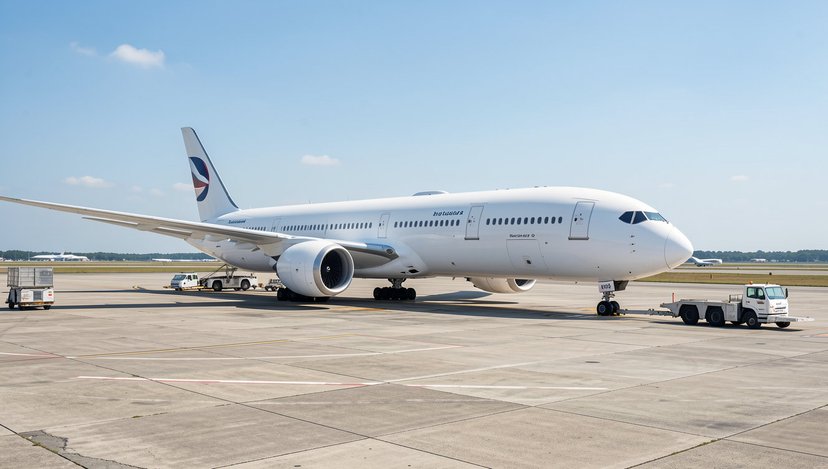
Boeing 787-9 Dreamliner

New York-air — CC BY-SA 4.0
The Boeing 787-9 Dreamliner is a wide-body, twin-engine jet airliner that serves as the stretched, primary variant of Boeing's composite-intensive commercial family. Designed to succeed older mid-size widebodies like the Boeing 767 and Airbus A330, the dash-9 bridges high capacity with exceptional intercontinental range, making it a cornerstone for point-to-point long-haul network strategies.
Standing as the commercial sweet spot of the Dreamliner lineup, the aircraft introduced advanced aerodynamics—such as raked wingtips and noise-mitigating engine chevrons—alongside an extensively digitized cabin environment featuring higher cabin pressure altitudes and larger dimmable windows. Powered by either General Electric GEnx-1B or Rolls-Royce Trent 1000 turbofans, the type unlocked numerous ultra-long-range direct connections previously uneconomical for mid-sized equipment.
By The Numbers
The Boeing 787-9 Dreamliner has established itself as the most commercially successful variant of the Dreamliner family. Program data shows that the 787-9 has accumulated over 1,480 orders, with more than 750 aircraft delivered to operators worldwide. As Boeing works through its substantial twin-aisle backlog, the 787-9 consistently leads widebody production output, supported by final assembly operations in Charleston, South Carolina.
The type is heavily utilized across major long-haul networks globally. Primary mega-operators of the Dreamliner family—heavily anchored by the 787-9 variant—include major carriers such as All Nippon Airways (ANA), United Airlines, American Airlines, and Qatar Airways, connecting high-density international and transcontinental city pairs across North America, Asia, and the Middle East.
Manufacturing
Where It's Built
Final assembly of the Boeing 787 Dreamliner family takes place exclusively at Boeing South Carolina in North Charleston, South Carolina. Production was historically split with the Boeing Everett Factory in Washington state, but Dreamliner final assembly was consolidated entirely in North Charleston starting in 2021.
The 787 program relies heavily on an extensive international and domestic supply chain where major structural sections are delivered substantially complete:
- Fuselage Sections: Mitsubishi Heavy Industries (Japan) builds the forward fuselage sections, Leonardo (Italy) produces central and aft sections, and Spirit AeroSystems (Wichita, Kansas, USA) manufactures the forward section. Boeing South Carolina fabricates internal aft-body structures.
- Wings and Box Structures: Mitsubishi Heavy Industries manufactures the composite wing boxes, while Kawasaki Heavy Industries (Japan) produces the fixed trailing edges. Subaru Corporation (Japan) constructs the center wing box.
- Empennage and Control Surfaces: Vertical fins and stabilizers are produced by Boeing's internal fabrication division in Tacoma, Washington, alongside specialized trailing edge flaps and rudders fabricated in Australia.
- Avionics and Systems: Rockwell Collins supplies primary flight displays and communication architectures, while Thales provides integrated flight display systems and core electronics.
The total documented development and initial production program cost is estimated across financial reports and industry analyses to be approximately $32 billion.
Notable Operators
Watch
Boeing 787-9 Dreamliner In Action
British Airways Boeing 787-9 Dreamliner full takeoff from Tokyo Haneda
Boeing Vietnam Airlines 787-9 Dreamliner Vertical Takeoff & Steep Turns 2015 Paris Air Show Prep
Safety Record
Notable Safety History
Regulatory authorities including the FAA and EASA have periodically issued mandatory Airworthiness Directives (ADs) concerning structural and mechanical issues identified through ongoing fleet monitoring and manufacturer investigations, leading to required engineering modifications and inspections.
Notable safety directives include:
- Wing Splice Plate and Fastener Inspection Mandates: Regulatory oversight prompted by manufacturing investigations into excessive preload forces and shim gaps at lower side-of-body splice plates led to mandatory ultrasonic and detailed inspections to mitigate potential fatigue cracking in primary wing structures.
- Electrical Power and Battery System Redesign: Following electrical anomalies and localized thermal events in early service, the FAA and global regulators mandated comprehensive redesigns of the lithium-ion battery containment systems, charger configurations, and venting arrangements under revised airworthiness standards before clearing the fleet to resume operations.
Covers officially investigated accidents only, per aviation safety authorities (NTSB, FAA, EASA, AAIB or equivalent).
Latest
Boeing 787-9 Dreamliner in the News


Sources & Further Reading
- Wikipedia - Boeing 787 Dreamliner ↗
- Aircraft Investigation Info - Boeing 787-9 Performance ↗
- Wikipedia - List of Boeing 787 orders and deliveries ↗
- Simple Flying - The Boeing 787-9 Dreamliner Is 2026's Most-Delivered Widebody ↗
- Simple Flying - Where is the Boeing 787 Dreamliner actually built? ↗
- Simple Flying - The 9 Countries Supplying Major Structural Components ↗
- Federal Register - FAA Airworthiness Directives (Model 787 Airplanes) ↗
- US Department of Transportation - Certification of the Boeing 787 and Lessons Learned ↗